Published airflow ratings do not always tell the full story of how a fan will perform in an actual system. Duct resistance, installation configuration, inlet and outlet geometry, rotational speed, and electrical conditions can all affect airflow, pressure, power input, and efficiency. For fan manufacturers, equipment developers, engineering teams, and procurement professionals, performance data generated under a defined test method provides a stronger foundation for design decisions and technical communication.

Located in New Taipei City, Taiwan, Ching Yuang’s Wind Tunnel Laboratory—Laboratory No. 4269—has been assessed and accredited by the Taiwan Accreditation Foundation (TAF) against ISO/IEC 17025 requirements. The laboratory focuses on performance testing for fans and related air-moving equipment, helping customers understand product behavior through measured data.

Why Fan Performance Testing Matters

Fan performance cannot be evaluated from one airflow value alone. As system resistance changes, airflow and pressure change as well. Testing at multiple operating points helps establish a performance curve and provides a more useful picture of how the unit behaves across its expected operating range.

Depending on the product, test objective, and applicable method, a wind tunnel test may record airflow, static pressure, rotational speed, voltage, current, input power, and related efficiency data. These results may support product development, design verification, model comparison, operating-point analysis, investigation of airflow or energy-use concerns, and preparation of technical information requested by customers or procurement teams.

Test results apply to the submitted sample under the stated setup and test conditions. Changes to the motor, impeller, enclosure, speed, or installation configuration may require additional evaluation before the original results can be applied to a modified product.

Two Wind Tunnel Systems for Different Fan Categories
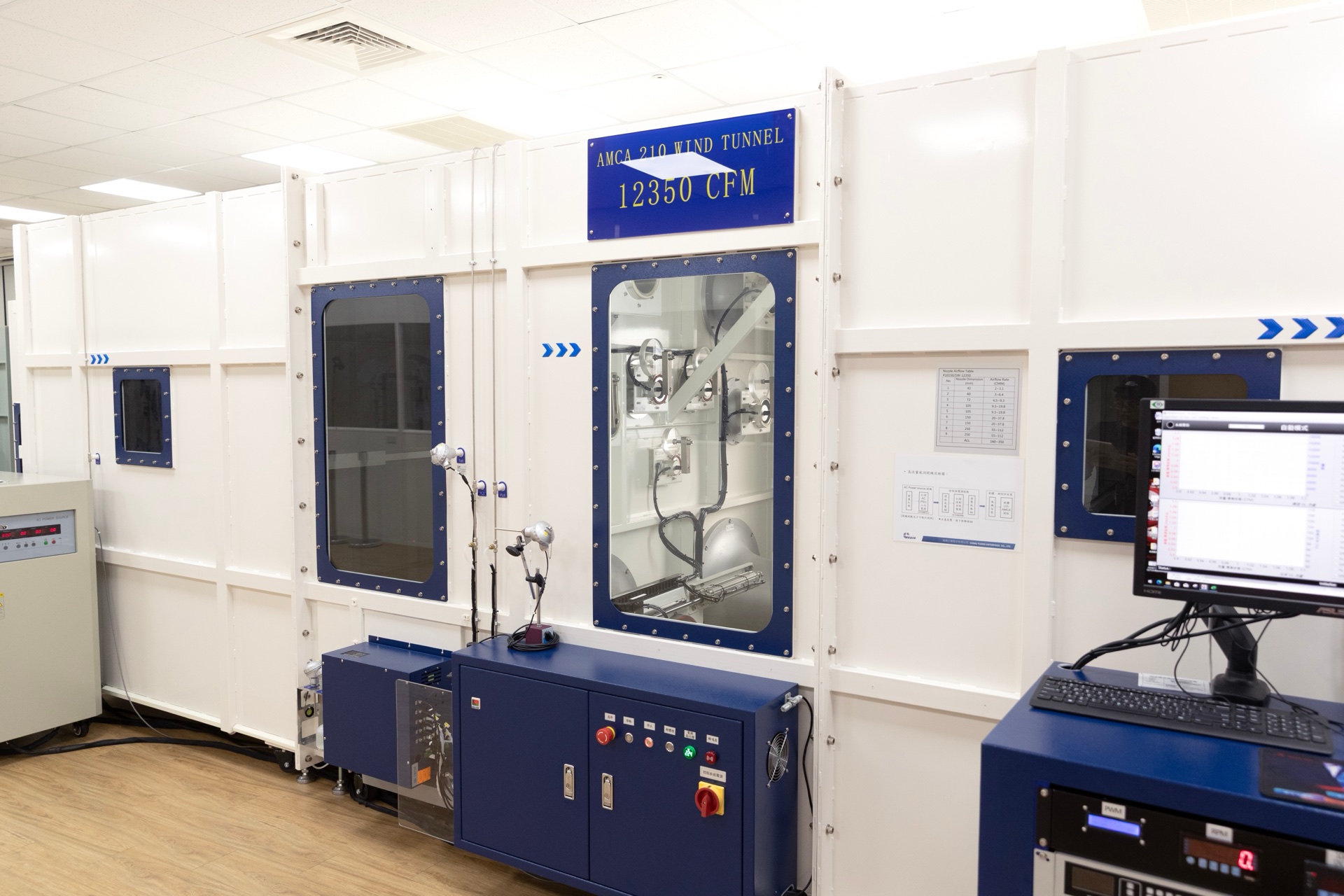
Large AMCA 210 wind tunnel and automated measurement equipment at Ching Yuang
The large wind tunnel system supports test airflow up to 12,350 CFM (350 CMM).

Ching Yuang’s laboratory has two wind tunnel systems. The first is designed primarily for compact precision cross-flow fans and supports test airflow up to 900 CFM (25 CMM). Cross-flow fans are commonly used in air-conditioning equipment, air-circulation products, electronics cooling, and internal ventilation assemblies. Because dimensions and flow-path configurations vary, sample size, inlet and outlet geometry, and mounting requirements should be reviewed before testing.

The second system can accommodate selected axial-flow fans, multi-blade fans, and exhaust fans, with test airflow up to 12,350 CFM (350 CMM). Actual eligibility depends on fan dimensions, required fixtures, test configuration, equipment capacity, and the requested method.
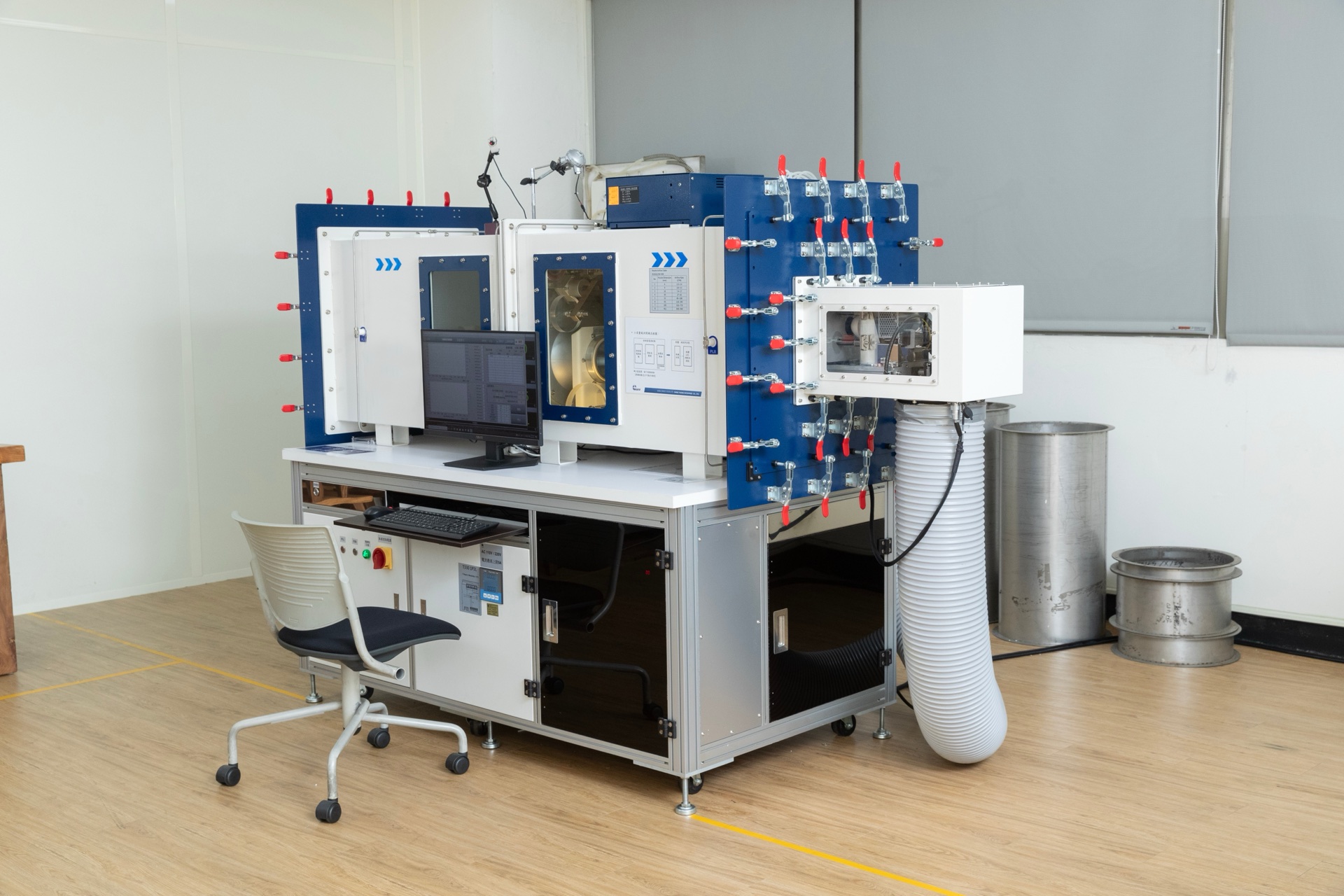
Compact precision cross-flow fan wind tunnel testing equipment at Ching Yuang
The compact system can be evaluated for cross-flow fan performance testing based on sample conditions.

Evaluating Test Methods Under AMCA 210, ISO 5801, and CNS 7778

Fan testing requires a clearly defined configuration, set of measurements, operating conditions, and data-reduction method. Based on the customer’s objective and the laboratory’s accredited scope, Ching Yuang can evaluate the applicability of methods associated with ANSI/AMCA 210, ISO 5801, and CNS 7778.

Not every fan can be tested under the same setup. The applicable method and configuration depend on the product type, dimensions, installation boundary, required test points, and intended use of the report. Before accepting a project, the laboratory reviews the technical information and confirms the proposed setup, mounting requirements, measurements, and reporting format.

If the report is intended for regulatory documentation, a public tender, procurement approval, or third-party review, customers should disclose those requirements during the quotation stage. This allows the laboratory to confirm whether the requested method and report format are covered by its current accredited scope.

Turning Manufacturing Experience Into Measured Data

For product engineers, wind tunnel testing can help compare changes in impeller geometry, motor selection, housing design, and airflow paths. For buyers and equipment users, measured performance data supports a more informed comparison than catalog ratings or subjective observations alone.

Ching Yuang has long been involved in fan manufacturing, application engineering, and performance improvement. The laboratory extends that experience into structured measurement and verification. In addition to commissioned performance testing, the technical team can discuss project-specific needs involving development analysis, performance investigation, and fan optimization.

Information to Provide Before Requesting a Test

  1. Fan type, model, and intended application
  2. Sample dimensions, weight, and inlet/outlet drawings
  3. Rated voltage, frequency, phase, power, and rotational speed
  4. Expected airflow, pressure, or operating range
  5. Requested standard or customer specification
  6. Purpose of the test and intended use of the report
  7. Sample quantity and preferred schedule

After receiving the information, the laboratory will evaluate equipment capacity, accredited scope, mounting requirements, and test conditions. If a custom fixture or transition section is required, it will be discussed before testing begins.

Frequently Asked Questions

Can every type of fan be tested?

Testing feasibility depends on fan type, size, airflow range, mounting arrangement, electrical requirements, and the requested method. Product drawings and electrical specifications should be submitted for an initial review.

Is a TAF-accredited test report the same as product certification?

No. A test report presents results for a defined sample under stated conditions and methods. Product certification, regulatory compliance, and procurement acceptance remain subject to the applicable authority, certification body, or purchasing organization.

How can a company request an evaluation and quotation?

Provide the fan model, dimensions, rated electrical data, target test range, requested standard, report purpose, quantity, and schedule. The laboratory will review the information and confirm the test items that can be performed.

Looking for a Fan Testing Laboratory in Taiwan?

Send Ching Yuang your product information and testing requirements for an initial technical review.

Explore Our Wind Tunnel Laboratory

Testing capabilities, accredited items, report statements, and use of accreditation marks are subject to the laboratory’s current TAF-accredited scope and the formal review of each project.

Ching Yuang concluded a successful four-day showcase at Automation Taipei 2026 and the Taiwan Automation Intelligence and Robot Show (TAIROS), held August 19–22 at Taipei Nangang Exhibition Center Halls 1 and 2.

As two of Taiwan’s most influential industrial technology events, the shows brought together manufacturers, automation specialists, semiconductor companies, and technology leaders focused on Industry 4.0, AI-enabled production, smart factories, robotics, and net-zero manufacturing.

At the Ching Yuang booth, visitors explored three proven Japanese industrial solutions: Suiden portable spot coolers, Shizuoka Seiki evaporative air coolers, and Tokyo Rikosha transformers and automatic voltage regulation equipment. Discussions throughout the show highlighted two increasingly important operational priorities: maintaining safer working temperatures and delivering stable power to sensitive production equipment.

A Practical, Layered Approach to Industrial Cooling

Industrial facilities rarely have a one-size-fits-all cooling requirement. Open production areas, warehouses, loading zones, operator stations, and high-heat equipment each require a different approach. For many facilities, the most effective solution is to combine broad-area evaporative cooling with targeted spot cooling.

Shizuoka Seiki Evaporative Air Coolers

Shizuoka Seiki evaporative air coolers use water evaporation to reduce surrounding temperatures by approximately 3–5°C. Their low power consumption, long air-delivery range, and ability to operate without discharging condenser heat into the work area make them well suited for open factories, warehouses, logistics centers, and other large spaces.

Suiden Portable Spot Coolers

Suiden portable spot coolers deliver focused cold air that can be approximately 10°C below ambient temperature. They are designed for operator workstations, production equipment, and localized high-heat zones where rapid, concentrated cooling is required. Because spot coolers generate condensate and exhaust heat, proper drainage and exhaust planning are essential.

These two technologies serve complementary roles. An evaporative air cooler can improve conditions across a larger area with low energy consumption, while a portable spot cooler provides additional cooling exactly where employees or equipment need it most. Used together, they can help manufacturers balance worker comfort, cooling performance, and operating cost.

Stable Power for Semiconductor and Smart Manufacturing Operations

As Taiwan’s semiconductor and electronics industries continue to expand, voltage stability and power quality have become critical to production reliability. Precision machinery, automated systems, and sensitive electronic equipment may require voltage step-up or step-down, automatic voltage regulation, power conditioning, and backup power planning.

Ching Yuang represents Tokyo Rikosha, a Japanese manufacturer with more than a century of electrical engineering expertise. Its made-in-Japan portfolio includes transformers, automatic voltage regulators, power controllers, and related power-stabilization equipment for semiconductor manufacturing, electronics production, industrial machinery, and automated production lines.

Supporting More Reliable Industrial Operations

Ching Yuang thanks every visitor and industry professional who joined us at Automation Taipei 2026. We will continue to bring dependable Japanese industrial technologies to Taiwan and provide application-based recommendations for industrial cooling, air quality, stable power, and smart manufacturing.

For assistance with factory cooling, portable spot coolers, evaporative air coolers, transformers, or voltage regulation solutions, please contact Ching Yuang. Our team can help evaluate your operating environment and identify a practical solution for your facility.

Event information: Automation Taipei and TAIROS.

As extreme heat becomes a more serious operational risk, Taiwan’s Ministry of Labor and the Occupational Safety and Health Administration have continued to call on employers to strengthen heat stress prevention for outdoor and high-temperature work environments. A recent Public Television Service report covered a heat hazard prevention and technology-based disaster reduction demonstration, where labor authorities emphasized the need for employers to improve on-site protection, cooling measures, rest areas, and follow-up inspections.

For business owners and site managers, the message is clear: heat stress is no longer only a seasonal comfort issue. It is a workplace safety, productivity, and business continuity concern. Construction sites, logistics yards, warehouses, factories, maintenance areas, agricultural facilities, outdoor events, and semi-open production spaces can all expose workers to elevated temperatures, direct sunlight, poor ventilation, and accumulated radiant heat. Without proper planning, these conditions may increase the risk of heat exhaustion, heat illness, fatigue, reduced concentration, and operational disruption.

According to Taiwan’s occupational safety guidance, employers should consider measures such as reducing workplace temperature, providing shaded rest areas, offering sufficient drinking water or appropriate beverages, adjusting work schedules, increasing site inspections, monitoring worker health, and preparing emergency response procedures. When heat risk reaches a higher level, the workplace should also consider practical cooling facilities such as shading, fans, water mist systems, and air-conditioned or well-ventilated rest spaces. In other words, heat prevention requires more than reminding employees to drink water. It requires a practical combination of equipment, site layout, and management discipline.

Planning Cooling Around Real Work Conditions

Ching Yuang Enterprise Co., Ltd. works with industrial and commercial customers that face very different site conditions. A metal-roof factory that stores afternoon heat requires a different approach from a loading dock, an outdoor repair area, or a temporary construction rest station. Before selecting equipment, Ching Yuang recommends that companies identify high-risk zones, review worker dwell time, check air circulation, confirm power availability, and understand whether the cooling equipment needs to be fixed, portable, or frequently repositioned.

Shizuoka Evaporative Coolers for Large and Semi-Open Areas

Ching Yuang represents Shizuoka evaporative cooling solutions for work areas that require strong airflow and flexible deployment. These coolers are well suited for factories, warehouses, logistics areas, maintenance shelters, and semi-open workstations where conventional fixed air-conditioning may not be practical. By combining airflow with evaporative cooling, Shizuoka coolers can help reduce the feeling of heat and improve air movement in larger work environments.

Suiden Spot Coolers for Targeted Cooling

For locations that need focused cooling near workers or equipment, Suiden portable spot coolers provide a practical option. They can be used around production lines, machine-side work areas, inspection stations, guard rooms, temporary offices, and rest areas where permanent air-conditioning is difficult to install. Targeted cooling can also help companies create cooling points for workers during high-risk periods.

Misting Fans and Industrial Airflow Solutions

Misting fans and industrial fan solutions from Chung Yi are especially relevant for outdoor and semi-outdoor applications, including temporary shelters, loading areas, agricultural facilities, event spaces, and construction-related work zones. By combining airflow with fine mist, these systems can support practical heat reduction in spaces where natural ventilation is available and full enclosure is not possible.

Lighting as Part of a Safer Work Environment

Cooling is only one part of workplace safety. When companies add shade structures, temporary rest areas, or night-shift work zones, visibility also matters. Ching Yuang’s professional lighting equipment can support safer work conditions by improving visibility in shaded, temporary, or low-light areas. A stronger heat stress strategy should therefore consider cooling, ventilation, lighting, rest areas, and workflow together.

From company profile and product applications to customer cases and exhibition demonstrations, Ching Yuang continues to build its reputation around practical industrial equipment solutions. For companies reviewing summer safety plans, Ching Yuang can support discussions around workplace cooling equipment, portable spot cooling, evaporative cooling, misting fans, industrial ventilation, and worksite lighting. As heat stress becomes a recurring business risk, proactive planning helps protect workers, reduce operational interruptions, and create a safer, more reliable work environment.

Ching Yuang Enterprise Co., Ltd. will introduce the TYVOX MINI air purifier to international buyers at Thailand MEGA SHOW, taking place in Bangkok from July 15 to 17, 2026. The exhibition marks the first public appearance of TYVOX in Thailand and represents an important step in Ching Yuang’s continued expansion across Southeast Asia.

As consumers and businesses place greater emphasis on indoor air quality, compact air care products are becoming more relevant in everyday environments. Homes, offices, hotels, retail spaces, meeting rooms, and personal work areas all share a growing need for products that are easy to deploy, simple to use, and visually appropriate for modern interiors. TYVOX MINI was developed for that practical market need.

The product is positioned as a compact air purifier for users who want cleaner, more comfortable air without the footprint or complexity of a large appliance. Its smaller format makes it suitable for desks, bedrooms, reception counters, hotel rooms, small meeting rooms, and other spaces where flexibility matters. For business buyers, this creates a wide range of potential use cases, from retail distribution and corporate gifting to hospitality procurement and cross-border e-commerce.

TYVOX MINI also reflects a broader shift in the air purification category. Buyers are no longer looking only for high-capacity equipment for large spaces. Many are also seeking approachable, design-conscious products that can fit naturally into everyday routines. A compact air purifier can help users address air quality concerns in a more personal and accessible way, especially in dense urban environments and shared commercial spaces.

For Ching Yuang, the launch of TYVOX MINI highlights the company’s ability to apply its product development experience to new categories. Ching Yuang Enterprise has worked across multiple product applications, including Ching Yuang balloon lighting solutions and other electronic product developments. That background gives the company a strong foundation in product execution, manufacturing coordination, and customer-focused customization.

Thailand MEGA SHOW provides a valuable platform for the product’s regional debut. The event brings together buyers, distributors, retail groups, sourcing teams, and brand partners from Thailand, Southeast Asia, and other international markets. By presenting TYVOX MINI in Bangkok, Ching Yuang aims to meet potential partners face to face, better understand regional market expectations, and explore new business opportunities in one of Asia’s most active commercial hubs.

The Bangkok debut is especially meaningful because it gives TYVOX its first direct exposure in Thailand. Southeast Asian markets continue to show strong interest in products that combine wellness, convenience, and accessible design. TYVOX MINI fits naturally into that trend, offering a product story that is easy to understand and relevant to both consumer and business environments.

Beyond the product itself, the exhibition underscores Ching Yuang’s commitment to international business development. A successful product launch today requires more than manufacturing capability. It requires clear product positioning, reliable execution, responsive communication, and an understanding of how buyers evaluate both the product and the company behind it. Ching Yuang Enterprise Co., Ltd. continues to build its reputation by combining dependable product development with practical service and market responsiveness.

For international partners reviewing Ching Yuang products, company information, electronics capabilities, exhibitions, customer cases, and recruitment updates, the company’s official website will continue to serve as a central source for news and product activity. Ching Yuang will also continue sharing trade show updates as it develops more opportunities with global partners.

Ching Yuang welcomes buyers, distributors, brand owners, sourcing teams, and business partners interested in compact air purification solutions to visit during Thailand MEGA SHOW from July 15 to 17, 2026. TYVOX MINI’s first appearance in Bangkok will offer a direct look at the product’s positioning, potential applications, and partnership opportunities as Ching Yuang continues to strengthen its presence in overseas markets.